
Transcript
Announcer:
Welcome to CE on ReachMD. This activity is provided by Medtelligence and is part of our MinuteCE curriculum.
Prior to beginning the activity, please be sure to review the faculty and commercial support disclosure statements as well as the learning objectives.
Dr. Owens:
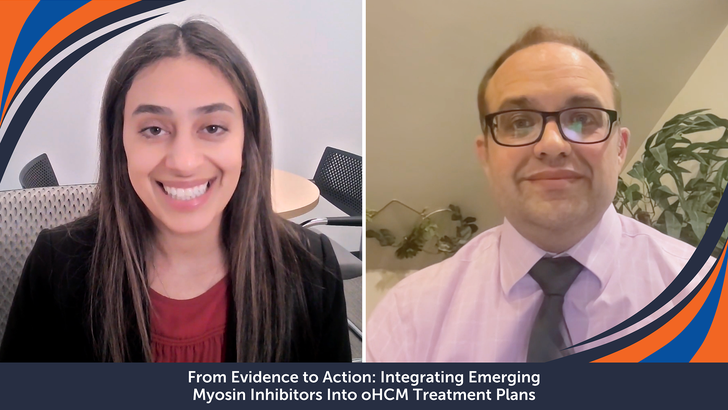
This is CE on ReachMD. I’m Dr. Anjali Owens, and here with me today is Dr. Michael Nassif.
Our question and topic for today, Michael, is as cardiac myosin inhibitors move into broader clinical use, how do the REMS requirements—that’s the Risk Evaluation and Mitigation Strategy program—influence your prescribing, monitoring, and patient counseling in everyday practice?
Dr. Nassif:
Yep. Thank you so much, Dr. Owens. And yes, I’m sure Dr. Owens’ practice and mine are prescribing myosin inhibitors. Mavacamten has kept our echo labs very busy. And there is very strict monitoring.
And one thing that’s happened with the new aficamten approval and the FDA REMS is it has some added flexibility. And so it starts with the lowest dose of aficamten, which is 5 mg, and we’ve all been very reassured as we’ve never seen significantly reduced ejection fraction with 5 mg of aficamten. And the flexibility comes in when the follow-up echocardiograms can be done as soon as 2 weeks and as late as 2 months, anytime between there. And so long as the ejection fraction remains above 55%, if there’s still obstructive gradient over 30, you should continue to up-titrate the medicine. If the ejection fraction is between 50% and 55%, it is recommended you maintain the dose. If the ejection fraction is between 40% and 50%, the drug dose should be decreased by 5 mg. And only if the ejection fraction is less than 40% is it recommended that the medication is halted. Ejection fraction, it’s verified to have improved, then restart at the lowest dose, 5 mg. And again, the patient and the providers have the flexibility to do these follow-up echocardiograms between 14 and 60 days. And once you have a stable dose and are on maintenance, you can go out to 6 months on the follow-up echocardiograms.
But again, which was encouraging to us is that in our trials of SEQUOIA and MAPLE, we had no patients that had to permanently discontinue drug for an ejection fraction less than 40%. But where it kind of fits in nicely, if you have a very symptomatic and motivated patient, you can titrate them as fast as every 2 weeks. If you have a patient that perhaps isn’t as symptomatic and it’s a little more burdensome, they live further away, they can take up to every 60 days to get their echoes. And then likewise once they get to their target dose, you can go to every 3 months on their echocardiograms.
Dr. Owens:
Yeah, that’s great. And I think the key word that you said there really, Michael, is flexibility, right? And I think that’s really what the REMS provides us with aficamten is the off opportunity to tailor the management to the patient. We’ll see how this plays out in the real world now that we have aficamten approved for use.
With mavacamten, we have a couple of hundred patients we’re following here and they’re doing very well clinically, and overall the safety profile has been excellent. But it is a more rigored program—once a month for the first 3 months and then after that we can space out for stable patients to every 6 months. But there were much more strict protocols with that REMS. And I think that in some ways our echo lab got very used to it, and now there’ll be some changes as they see that there’s flexibility built in with a new drug.
And what sort of structure have you set in place with your echo lab? Do you do limited follow-up echoes for the titration visits and then every so often do a full echo? Or what’s been your protocol there?
Dr. Nassif:
Exactly. And so we have a bunch of echo slots 4 days a week that are kind of certain sonographers, and they’re limited echoes for LVOT gradients, LV functions, and MR mostly. We still try to get a full echocardiogram at least every couple of years just to make sure we’re not missing anything else in the big picture and do more focused measurements of left atrial volumes and more subtle diastolic function and other parameters.
Is it similar to you guys at Penn?
Dr. Owens:
Yeah, very similar. And with this class of medications you really want to look at gradient for efficacy, ejection fraction for safety. One thing to consider are drug–drug interactions. We know that both the cardiac myosin inhibitors are metabolized through the cytochrome P450 system. So it’s important to look at the list of medications that your patient’s on and if any new medications are prescribed. The drug–drug interactions are a bit different between the 2 medications, and it’s important to look at that. With the new aficamten REMS, there is no mandate for the specialty pharmacist to do a drug–drug interaction checklist. So the physician in clinic at your routine visit would do the drug–drug interaction checklist.
So thank you to the audience for joining us today. That’s all we have time for and thank you, Dr. Nassif, for joining.
Dr. Nassif:
Thank you.
Announcer:
You have been listening to CE on ReachMD. This activity is provided by Medtelligence and is part of our MinuteCE curriculum.
To receive your free CE credit, or to download this activity, go to ReachMD.com/CME. Thank you for listening.
 In support of improving patient care, Global Learning Collaborative (GLC) is jointly accredited by the Accreditation Council for Continuing Medical Education (ACCME), the Accreditation Council for Pharmacy Education (ACPE), and the American Nurses Credentialing Center (ANCC) to provide continuing education for the healthcare team.
  Global Learning Collaborative (GLC) designates this activity for 1.00 contact hour(s)/0.10 CEUs of pharmacy contact hour(s).
  Global Learning Collaborative (GLC) has been authorized by the American Academy of PAs (AAPA) to award AAPA Category 1 CME credit(s) for activities planned in accordance with AAPA CME Criteria. This activity is designated for 1.00 AAPA Category 1 CME credit(s). Approval is valid until
